Adaptive Tuning of Event-Triggered Control based on Machine Learning: Application to Mobile Robotics
Jul 17, 2025·


 ·
0 min read
·
0 min read
Maya Pivert
Equal contribution
Inas Belrhazi
Equal contribution
Florian Pouthier
Sylvain Durand
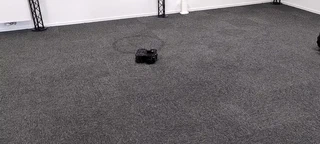 Image credit: Maya Pivert
Abstract
This paper looks at optimizing the frugal navigation of mobile robots by combining event-triggered control with artificial intelligence techniques. Event-triggered control updates the control signal only during significant changes in the system dynamics or its environment, thereby reducing the usage of limited onboard resources. This work is based on a discrete-time linear quadratic event-triggered control approach, which comes with a constant tuning parameter to set the tradeoff between resource utilization, performance, and control effort. Machine learning methods (linear regression and neural network) are explored to make this parameter dynamically adaptive to enable better and sparser trajectory tracking. Both simulation results on a digital twin and experimental results on a real two-wheeled robot show that combining event-triggered control with machine-learning techniques can efficiently improve robot navigation, offering adaptive and robust solutions across various configurations.
Type
Publication
IFAC Joint 10th Symposium on Mechatronic Systems & 14th Symposium on Robotics
Status
Peer-reviewed
Open access
License
CC-BY-4.0

Authors
Doctor in Control and Robotics
My research focuses on the efficient navigation of UAVs in constrained environments. I recently joined the LEASARD CominLabs project at LS2N Nantes, in which I investigate SLAM and navigation algorithms with event-based cameras to improve drone autonomy in cluttered environments. This work is supervised by Isabelle Fantoni. My Ph.D. thesis work, led at ICube Strasbourg and GIPSA-lab Grenoble, has been dedicated to the event-driven navigation of a drone in dark environments, as a part of the dark-NAV ANR project. This thesis has been supervised by Nicolas Marchand and Sylvain Durand. Through my research work, I developed research interests in aerial robotics, robust control and set theory. As a graduate of an engineering school (INSA Strasbourg), I have developed a taste for control theory, which I try to deploy as much as possible on real control systems.